
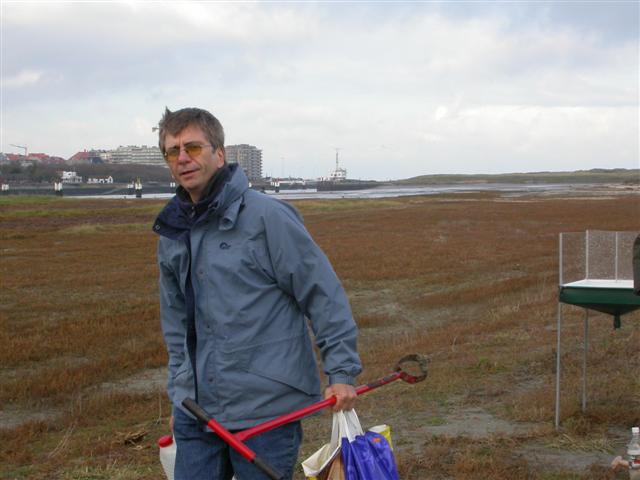
Konjev sampling at the research site in Nieuwpoort, winter 2004-2005
On September, 9th 2008, our dear friend and colleague Konjev Desender passed away. During most of his scientific career, he worked particularly on ground-beetles (Coleoptera, Carabidae) and he was, without a doubt, one of the most active and most respected European entomologists. Many fellow carabidologists knew him personally and were involved in his projects and publications in one way or another. From numerous meetings he was known as a scientist who always gave interesting lectures, as well as a man who was a fine and humorous companion during the evenings. Below, we will give a comprehensive description of his life and scientific career, completed with his impressive list of publications. We also intend to pay special attention to his life and work in the future, especially at the 14th European Carabidologists Meeting. We will look for an appropriate way to posthumously thank him for his valuable contributions to science.
Youth
Konjev was born in 1956 in Poperinge, Belgium. In a country that is in a way divided by the French and Dutch language, he showed remarkable linguistic talent for French as well as for its local dialects even though he grew up as a Dutch speaking schoolboy. In that period he also won several rhetoric competitions and was even delegated to the national level. His first interest in natural history was devoted to birds and due to his curiosity he became a member of a local group of bird ringers when he was just nine years old. Paul Houwen and his wife Thérèse, who were the leaders of this group, educated the young Konjev to a skilled ornithologist. He spent a lot of time in monitoring and ringing and in 1972, together with others, he published a booklet on hibernating black birds, which was distinctively awarded.
Academics and career
In 1974 he started his studies at the University of Ghent, which he ended as M.Sc. in 1978 with a licentiate in zoology with "Greatest distinction". At some time he must have changed his main interest from ornithology to entomology. It is not easy to reconstruct at which point or for what reason he chose carabids as a suitable group to study his scientific questions. Certainly the young Konjev had a broad interest in all kinds of biological matters, so he obviously made this decision well-considered somewhere during his academic studies. Jean-Pierre Maelfait, who shares more than 100 (co-)authorships with Konjev and who was his scientific companion from the beginning, is quite sure that the famous book by Thiele (1977, Carabid Beetles in their Environments) must have played an important role. Konjev considered carabids a suitable group, because they had a good taxonomic basis and yet there was enough left for him to discover. For the period 1978-1979 he obtained a grant of the Institute for Encouragement of Scientific Research in Industry and Agriculture and from 1979 to 1982 he worked as a Fellow of the National Fund for Scientific Research (NFWO). From 1982 to 1990 he was Assistant to the chair of Animal Ecology, Zoogeography and Nature Conservation at the State University of Gent. In the academic year 1986-1987 Konjev wrote his 346 pages counting doctoral thesis: "Bemonsteringsmethodologie, levenscyclus en evolutionaire ecologie van het dispersievermogen bij loopkevers" (sampling methods, life cycle and evolutionary ecology of dispersal power in ground beetles). An elaborated summary of this thesis was published in 1989 as a KBIN document.
Projects
Konjev was involved in many projects, for example: 1) Evolution and conservation of beetles in the Galapagos Archipelago (Ecuador), 2) Sampling methodology, biometrics and population genetics, 3) Biogeography, ecology and Red data on Belgian carabid beetles, 4) Case studies on the practical use of carabid beetles in bio-indicator projects and nature conservation, 5) Habitat fragmentation and genetic diversity/differentiation in forest and salt marsh beetles at a regional (Flanders and Belgium) and Euro-Mediterranean scale. It is not easy to classify his numerous subjects since they cover many aspects of biology, such as taxonomy, faunistics, biogeography, ecology, population biology, evolutionary studies, genetics, conservation biology and archaeology.
Publications
The result of Konjev's 30-year career is impressive and covers an overwhelming number of subjects. The list of published papers counts at this moment 359. From this list he is first or single author of 186 publications and over 145 have been published in international journals or books. Over 230 of the publications in which he was involved are in English, about 20 in French and the remainder in Dutch language. Additionally, 47 papers (first or single author of 25) and reports (together over 1500 pages) have been written but were not published; among these the first carabidological report of 1979 and his above mentioned doctoral thesis (1987). A special field of Konjev's interest was archaeological entomology to which he devoted about 20 papers. This enormous number could only be reached because his personality and broad interest allowed him to cooperate with almost everybody he encountered in his scientific environment. He attended over 90 scientific meetings (among which 58 international congresses). He authored 20 project reports and was editor in chief of the book 'Carabid beetles: ecology and evolution' (1984) with 71 papers resulting from the 8th European Carabidologists Meeting in Louvain la Neuve, organised by him and his Belgian colleagues.
The man
Despite the enormous working power and scientific production, Konjev was absolutely no scientific monomaniac. He was always looking for good reasons to socialise and leave the work behind for a while. As a burgundic Flemish, he loved a good meal and enjoyed pleasant company very much. During dinners and evenings he could be a real entertainer who was in no way restricted to entomology or science. Interested in numerous fields, he could discuss all kinds of subjects, putting things into perspective and/or joke about it. Konjev was also brilliant in finding quick solutions for (seeming) problems. When in 1992 a young European scientist from Eastern Europe asked if it was possible to introduce him in a proper way to the western carabidological world, Konjev immediately answered: "Ask him if he is prepared to be chairman for the next meeting". So happened, and it proved to be the right decision, because recently this person organised one of the most successful carabidological meetings we have ever seen. Also in sharing information he was exceptionally "easy going". When he had a good feeling about cooperation, he gave unconditional access to his basic data and provided all that was necessary to operate it. We remember him as a warm person, the kind of colleague that makes you look forward to every next meeting where he will be present. During the last meeting in Bulgaria 2007, the organisation paid special attention to his illness and spoke out that all participants sincerely hoped that his absence from the meeting was temporary. Knowing now that we will have to miss him forever, gives us a very sad feeling. What remains is gratitude about a rich scientific heritage, the fact that we were so lucky to have worked with him and having enjoyed his company. We sincerely thank him for that. Konjev leaves behind an intensely sad, but also thankful family and many good friends. We will never forget him.
Family and carabidological friends.